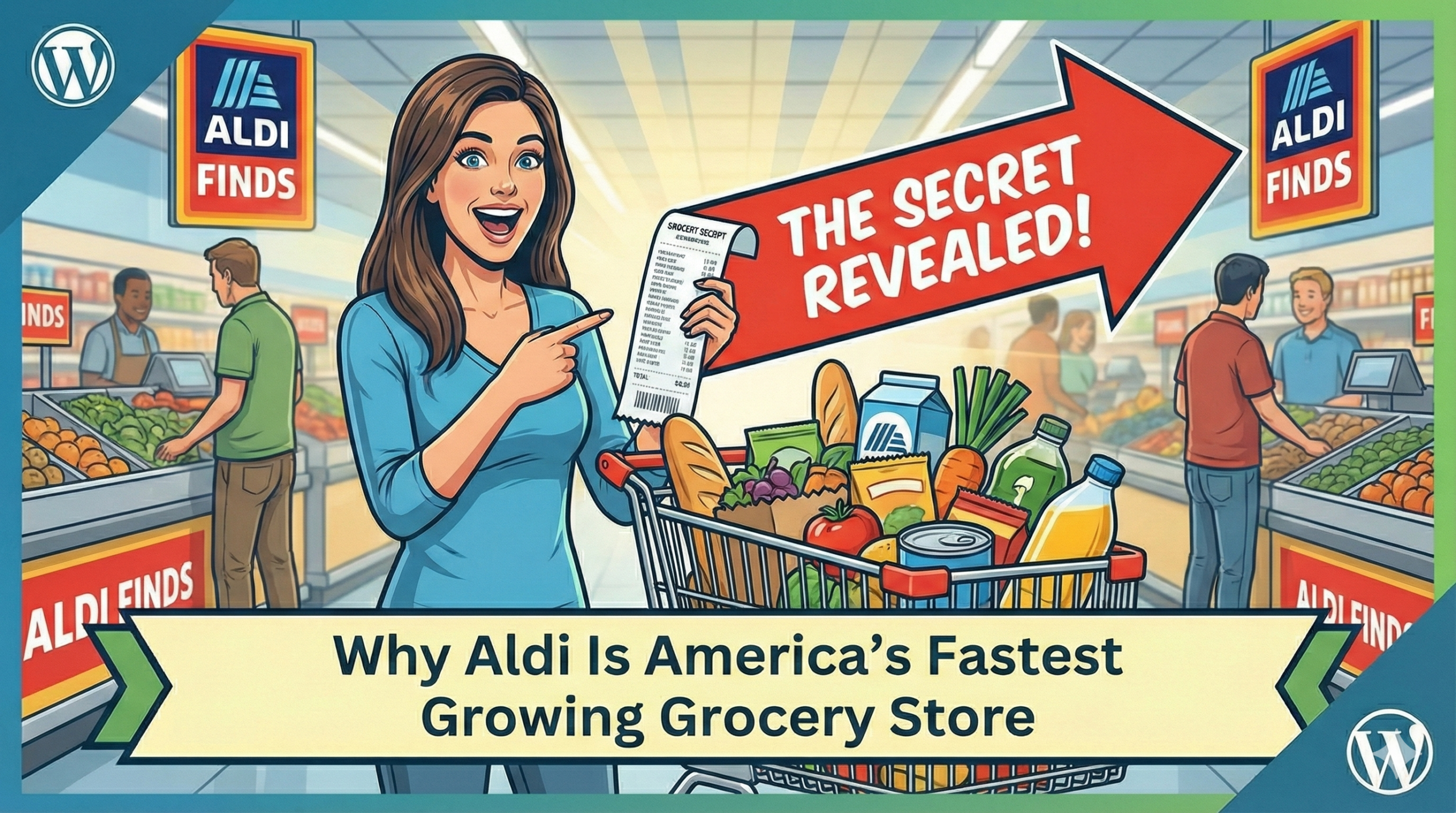
Why Aldi Is America’s Fastest Growing Grocery Store

1. Extreme Efficiency & Store Layout

  • Store Size: Aldi stores are small, typically around 12,000 square feet. This is comparable to Trader Joe’s but much smaller than the average supermarket.

  • Cost Savings: The smaller footprint reduces costs for property, rent, and utilities.

  • Layout Design: The store is designed to minimize the number of footsteps required to service it. There are no extra services like help desks, fresh bakeries, or butchers to keep labor costs low.

2. Limited Inventory & Staffing

  • Product Count: While typical supermarkets carry ~31,000 products and Trader Joe’s carries ~4,000, Aldi stocks only about 1,600 items.

  • Shelf Stocking: Products are displayed in the boxes they were delivered in. This saves employees time on stocking shelves, allowing Aldi to run the store with just 3 to 5 employees on the floor.

3. Psychology of “Cheap”

  • Compensatory Inferences: Marketing experts explain that when customers see low prices, they often assume low quality. Aldi uses its “No Frills” environment (quarters for carts, boxes on shelves) to signal that the low prices are due to efficiency, not poor quality.

  • Known Value Items: Aldi keeps prices low on staple goods (milk, eggs, bread)—items where customers have the best price memory. When these are cheap, customers infer the whole store is a bargain.

4. Private Label Strategy

  • 90% Private Label: The vast majority of Aldi’s stock is its own brand. This allows them to bypass national brand markups and deal directly with manufacturers for the best cost.

  • Copycat Branding: unlike Trader Joe’s unique items (e.g., Ube Mochi), Aldi’s private labels are designed to look like famous national brands (e.g., “Thin Wheat” instead of “Wheat Thins”). This signals to the customer that they are getting the same product for less.

5. Growth During Economic Downturns

  • Recession Proof: Aldi thrives when the economy struggles. The 2008 financial crisis kickstarted their growth strategy of opening ~100 stores a year.

  • Customer Retention: Interestingly, customers acquired during recessions tend to stay even when the economy improves. They have successfully expanded their demographic from just bargain hunters to anyone seeking convenience.
This happened in the UK around 2009. Aldi and Lidl were originally seen as discount stores that people were ashamed to shop at, but when the economy turned bad suddenly Aldi became the most popular food store and the legacy grocery stores had to scramble to compete. Now they compare themselves to Aldi when talking about prices or quality.

Misses one some of the most important factors. Aldi is privately run, has no shareholders to pay and runs on wafer thin profit margins (1%). It will always beat the competition on price. Second, it does not compromise quality and shoppers quickly learn to trust their own branded goods. Aldi is a very straightforward proposition: low prices, good quality, no frills. People understand it. Third, they are good at adapting to local markets. When they first came to the UK they were like the German stores.

There are still some remnants of that ( eg stollen at Cmas) but the stores completely adapted for the UK market. I noticed the US stores have wider aisles as US shoppers like bigger carts. They get those things right. Fourth they pay their staff properly. They work very hard (you never see them chatting) but they pay above minimum wage. Finally the central aisle retains shopper interest. People like novelty and buy all sorts of things they didn’t know they needed. I don’t know Trader Joe’s but they are in for a very hard time.

Aldi in Germany is split into two companies: Aldi North and Aldi South. The two branches differ in the color of their logos and partly in their product ranges. This division goes back to the founders, brothers Karl and Theo Albrecht, who split the company into two separate parts in the 1960s. It’s interesting that Aldi has also been so successful internationally, especially in the USA. The stores there are part of Aldi South, which you can recognize by the logo’s color scheme. Aldi North is also in the USA but operates under the name Trader Joe’s, as this chain was bought by Aldi North.

What’s remarkable is that Aldi’s concept – focusing on low prices, private-label products, and a smaller range with limited service – works even in a market like the US, where people are used to a higher level of service. It shows that the mix of efficiency and low prices appeals to customers worldwide. On the other hand, Walmart, the world’s largest retailer, didn’t succeed in Germany. After struggling in the 1990s and 2000s, Walmart had to pull out of the German market, partly because of tough competition from discounters like Aldi and Lidl.

ALDI also treats its suppliers, especially farm producers better here in Australia than our bigger supermarket chains. They pay the farm suppliers in a timely manner usually within a month, unlike the big supermarket chains that withhold payment for up to six months. Some ALDI products have also been found to be far superior in performance (think, dishwasher tabs, laundry products, etc) by Choice, a not for profit consumer goods blind testing facility which helps Australian consumers make better consumer choices. On the basics ALDI can’t be beaten for value.

As a German, shopping at Aldi for the last 30+ years its interesting to see how long it took Aldi and its model to get to the US. I always wondered why in the US they are paying such insane prices when shopping for groceries while at Aldi you have most of the time amazing quality at amazing prices. Though reduced selection, fruits and vegetables are most of the time superior in quality/freshness/price to normal supermarkets and in many cases sourced locally/nearby farmers.

In the same way, I was surprised to discover about ten years ago that manufacturers will sell the same food products under different brand names in the same country but in different store chains. This even happens with bottled waters. I love the Glacier Isle water from Rite Aid drugstores and yet, the same water is sold under four different names at four different stores. It’s Iceland Pure at Walgreen’s, Iceland Spring at Tops, Iceland Lava at CVS, and Skyra at 7-11. At first, it seems confusing to compete against your own product with so many different names, but it’s actually quite smart from a marketing perspective when you think about it.