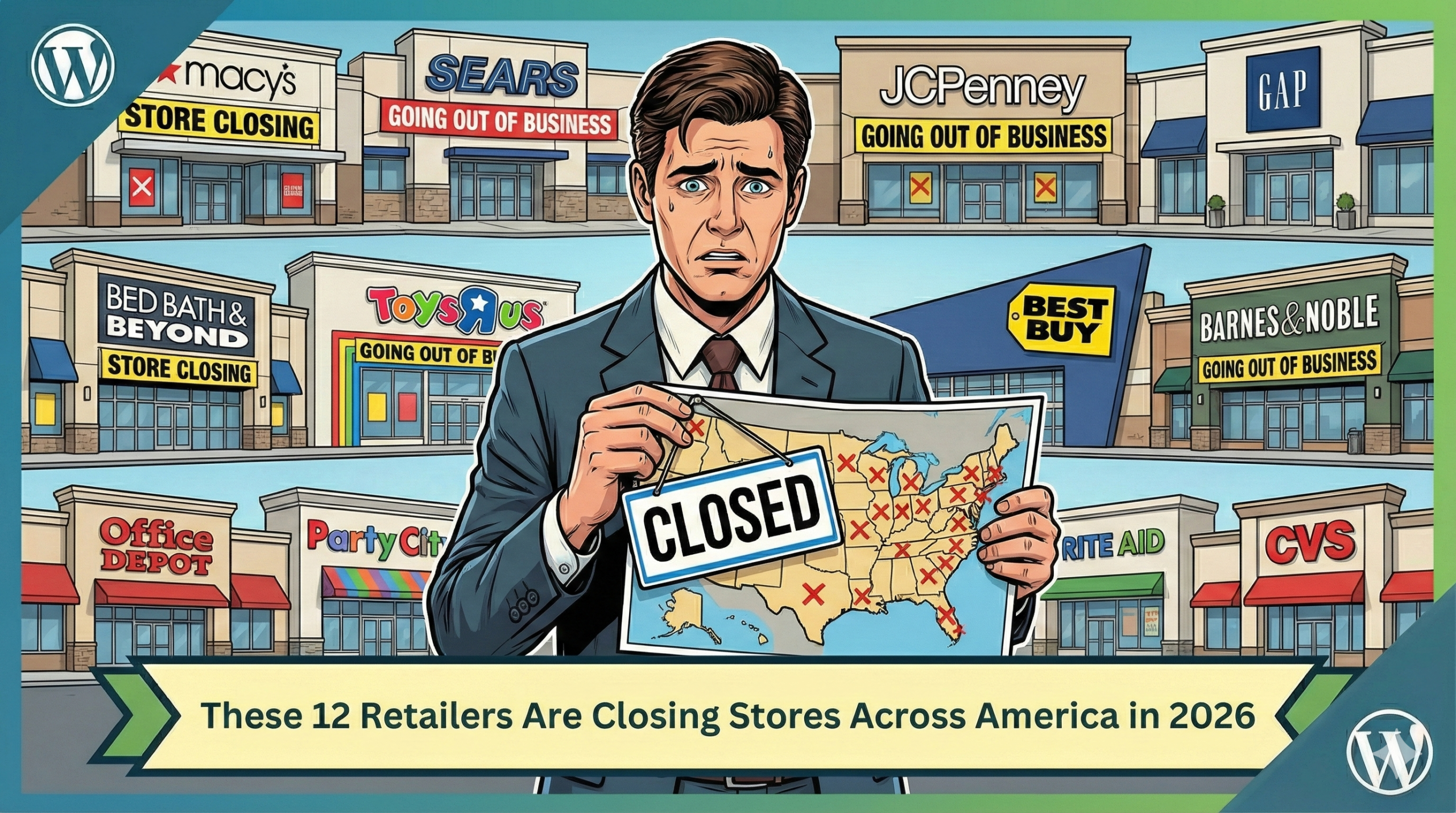
The “Retail Apocalypse” Overview
-
Context: Over 7,320 stores closed in a single year according to Coresight Research. The crisis is driven by consumers proactively withdrawing due to high prices and poor experiences, not just poverty .
List of 12 Retailers Closing Stores
1. Walmart
-
Situation: Even the largest retailer is closing stores in difficult-to-serve areas (e.g., California) due to high operating costs and theft.
-
Key Stats: Reported revenue of ~$681 billion but carries ~$40 billion in long-term debt. Cut approx. 500 corporate positions in tech/e-commerce to restructure .
-
Impact: Creates a “community void” where local ecosystems rely on Walmart for traffic and jobs.
2. Walgreens
-
Situation: Described as a “systematic withdrawal.”
-
Key Stats: Announced plans to close 1 in 4 stores (approx. 1,200 stores within 3 years). Agreed to pay ~$300-350 million to resolve opioid prescription allegations .
-
Impact: Creates “pharmacy deserts” forcing elderly and vulnerable populations to travel further for medication.
3. CVS
-
Situation: Reshaping from a retail pharmacy to a healthcare service provider, but shrinking its footprint.
-
Key Stats: Confirmed plans to close 271 stores in 2025. Already closed approx. 900 stores between 2022 and 2024 .
-
Impact: Losing “safe zone dots” on the map; healthcare access becomes dependent on zip code.
4. Macy’s
-
Situation: The anchor of the American mall is retreating under its “A Bold New Chapter” strategy.
-
Key Stats: Will close approx. 150 underperforming stores by 2026, focusing investment on the remaining ~350 stores .
-
Impact: When an anchor like Macy’s leaves, it often triggers the collapse of the entire mall ecosystem (food courts, small shops).
5. Joann Fabrics
-
Situation: Unlike others restructuring, Joann faced total collapse following a bankruptcy filing.
-
Key Stats: Faced with closing all stores after bankruptcy. Had approx. 800 stores and 19,000 employees at the time of filing .
-
Reason: The pandemic “crafting fever” broke, and consumers cut back on non-essentials.
6. Kohl’s
-
Situation: Stuck in the middle—not cheap enough to be a discounter, not distinct enough to be high-end.
-
Key Stats: Closing 27 underperforming stores by April 2025 .
-
Reason: Loss of identity; coupons and promotions no longer drive foot traffic as online pricing is transparent.
7. Dollar General
-
Situation: “Poverty is becoming more expensive.” Even the store for low-income earners is struggling.
-
Key Stats: Closing 96 general stores and 45 other stores in Q1 2025 .
-
Reason: Core customers can no longer afford even cheap goods due to inflation; stores suffer from understaffing and chaos.
8. Subway
-
Situation: A victim of over-expansion and “cannibalization” (stores competing with each other).
-
Key Stats: Net loss of 631 restaurants in 2024, dropping below 20,000 U.S. locations for the first time in 20 years .
-
Reason: Franchise model forces individual owners to bear costs while revenue dilutes across too many locations.
9. Best Buy
-
Situation: suffering from “Showrooming”—customers test products in-store but buy them cheaper on Amazon.
-
Key Stats: Closed 24 stores in 2024; expects to close 10-15 stores in fiscal 2025 .
-
Impact: Reduces places where consumers can get real, in-person advice and repairs.
10. 7-Eleven
-
Situation: The “24/7” model is becoming a liability due to labor costs and declining late-night traffic.
-
Key Stats: Closing 444 stores in North America .
-
Reason: Shift in consumer behavior (buying less tobacco, visiting less often) and rising operating expenses.
11. Big Lots
-
Situation: The discount model failed when inflation made “savings” feel non-existent.
-
Key Stats: Filed for Chapter 11 bankruptcy in Sept 2024; hundreds of stores listed for closure/transfer .
-
Reason: “Discount retail sometimes dies not because it sells expensive goods, but because people no longer have enough purchasing power.”
12. J.C. Penney
-
Situation: A “ghost” of the mall era, continuing a slow, quiet disintegration.
-
Key Stats: Closing an additional 8 stores in 2025. Has closed ~200 stores since its 2020 bankruptcy
-
Impact: Represents the loss of the “middle-class stage” and cultural anchor for suburban life.
Retail theft is a significant problem. When retailers suffer losses, they will make honest customers pay for them, which is unfair to consumers. Customers had had enough and were holding back, buying only necessary items. State laws don’t really protect retail stores the way they did before, and even consumers are afraid to shop there because of this.
You can’t build back Main Street USA, if all the big box stores are still breathing. This is your chance, folks. Get out there and rebuild your small town Main Streets and TAKE BACK AMERICA from all the things you hated about the old world you killed. Well, this is part of killing off the old world so you kids can have your “new world”, which obviously doens’t include making change for cash, thats out of their depths for the most part. We are in that “inbetween” times where we have to wait for the children to grow up.
Walmart is the store to avoid no matter what. They have literally tripled prices on some of their items. While we can barely buy groceries and pay our bills, Walmart is refurbishing their store (trainyards Ottawa, Ontario) and padding their pockets. If Walmart colapses, they did it to themselves! And they’ll deserve it!!!!!
WHAT THESE IDIOTS DON’T REALIZE IS THAT THE MODERN WORLD IS GOING THRU A PHASE, AND SHOPPING MALLS AND BRICK AND MORDER STORES ARE DISAPPEARING AND BEING REPLACED BY INTERNET STORES AND SHOPPING! EVEN AUTO SALES WILL ALL BE ON-LINE AND NO MORE AUTO DEALERS WILL BE FOUND BEYOND THE INTERNET!